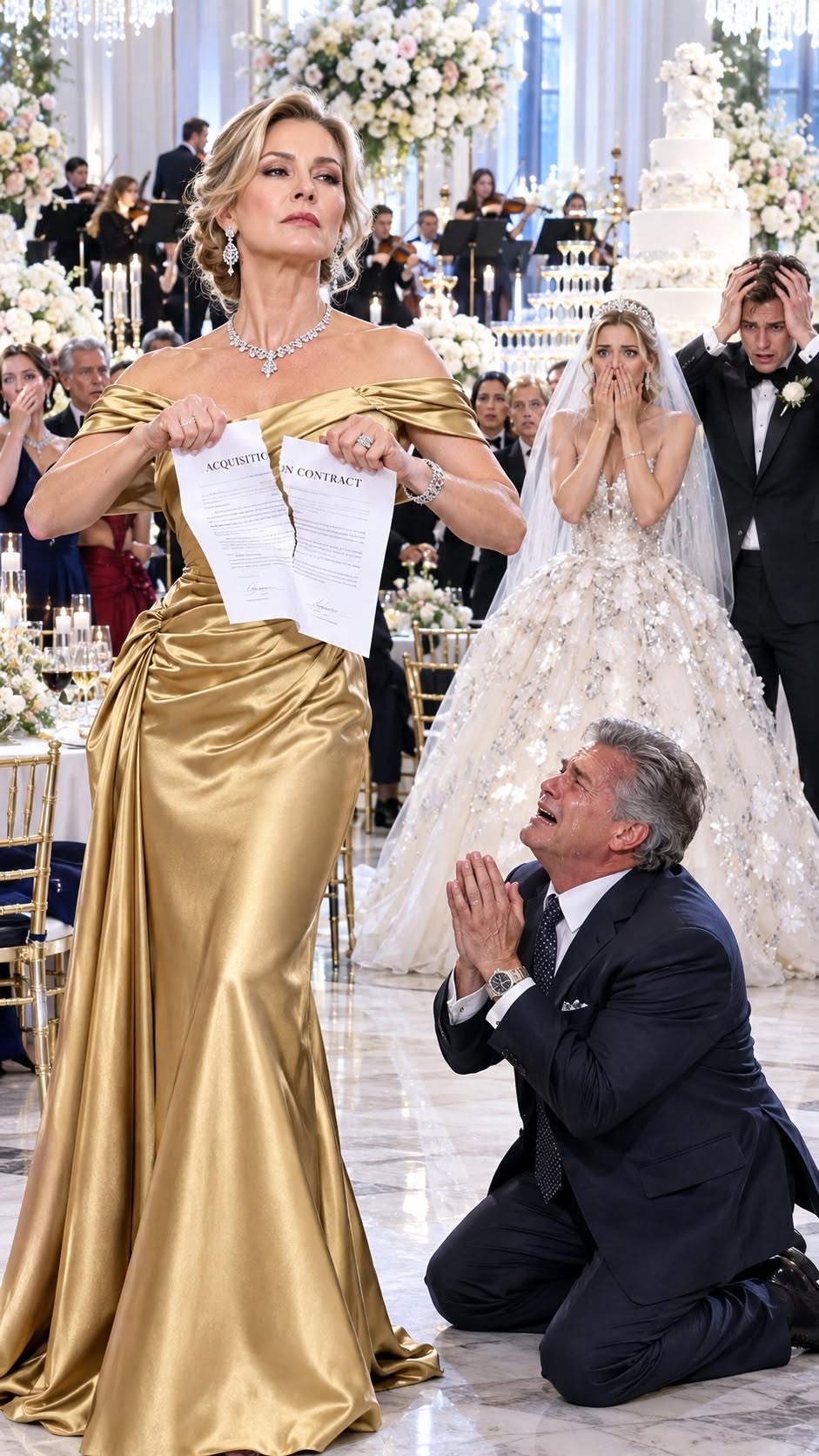
Chapter 1: The Ghost in the Ledger
For three decades, I have cultivated a species of influence that the world rarely recognizes. It is a silent authority, one that refuses to broadcast its presence through tailored Chanel suits or the obnoxious glint of a diamond tennis bracelet. I am a woman who appreciates the quiet hum of a well-oiled machine over the deafening roar of a parade.
When a man I had never met looked me dead in the eye at my only daughter’s rehearsal dinner and declared I wasn’t important enough to warrant his breath, I didn’t raise my voice. I didn’t slam my fist against the mahogany table. I simply reached for my phone, dialed a secure line I hadn’t utilized in years, and uttered a handful of syllables that would systematically dismantle his corporate empire before the waiter could clear our appetizer plates.
He had absolutely no inkling of the leviathan he had just casually provoked. By the time the realization finally dawned on him, the water was already over his head.
People often operate under the delusion that when a person accumulates staggering wealth, they possess a biological imperative to showcase it. I understand the psychology behind the assumption. Most individuals in my tax bracket crave the validation: the corner office boasting floor-to-ceiling panoramic glass, their surname etched in brushed steel above a lobby, the glossy profile in Forbes carefully lit to highlight their formidable presence.
I discarded those appetites a long time ago. Specifically, the day my husband, Michael, passed away.
It was an aneurysm. Sudden, violent, and devoid of the agonizing grace period that allows for final words. He died when our daughter, Emily, was just eleven years old. I vividly recall standing in the sterile stillness of our kitchen a week after the funeral. I watched Emily mechanically eating a bowl of cereal, her small shoulders curved inward, and I experienced a moment of crystalline clarity. I had a choice. I could continue mutating my firm, Reed Capital Partners, into the sprawling, voracious behemoth it was rapidly becoming, or I could raise the only living fragment of Michael I had left.
I chose Emily. I have not entertained a single second of regret since.
My retreat from the public eye was deliberate and absolute. I relinquished the visible helm of the firm to lieutenants I trusted with my life, restructuring my equity through a labyrinthine holding company that scrubbed the name Josephine Reed from every public-facing document. I still held the reins. Every catastrophic risk and monumental acquisition eventually required my signature, but I tended to my financial garden from behind an opaque, impenetrable fence.
Emily grew up operating under the vague assumption that her mother managed investments—a mundane description a child accepts without probing. She lived in a comfortable but unremarkable house. She was raised by a woman who coached her middle-school softball team, a mother who drove the exact same battered Ford truck for twelve years simply because the engine purred and she despised wasteful vanity.
What she did not know, what remained classified strictly within my innermost circle, was that Reed Capital had stealthily evolved into one of the most formidable private investment funds on the Eastern Seaboard.
And hidden deep within that tangled canopy of holdings sat a massive equity position in the Carter Group.
I hadn’t engineered the connection. Finance is a small world, and capital possesses a strange, magnetic irony. My chief strategist and oldest friend, David, had brought it to my attention months prior during a quarterly audit.
“Peculiar coincidence,” David had murmured, sliding a manila folder across the expanse of my desk. “Carter Group. Isn’t that the family your daughter is marrying into?”
I had stared at the embossed logo on the folder, feeling a cold, nameless knot pull tight in my chest. I chose silence. I wanted Emily to navigate her love for Daniel, her fiancé, without the distorting lens of my portfolio. But as I stared at the financial architecture of the Carter family’s upcoming endeavors, I realized their entire future hinged on a singular, massive technology acquisition. An acquisition they were recklessly underfunded for. An acquisition that required a final, $200 million tranche of private equity.
Equity that, through four layers of corporate obfuscation, belonged entirely to me. I closed the file, unaware of how soon I would need to weaponize it.
Will the Carters prove worthy of my daughter, I wondered, or will I have to show them exactly who holds their leash?
The months preceding a wedding are meant to be steeped in a soft, golden anticipation—cake tastings, the rustle of silk swatches, the profound joy of watching your child architect a life of her own choosing. For Emily and Daniel, however, that joy rapidly curdled into an exhausting diplomatic mission. I observed the deterioration from the sidelines, exercising a patience that ground my molars to dust.
It began with insidious, microscopic infractions. Daniel’s mother, Margaret Carter, possessed a smile that seemed permanently stretched over an underlying grimace of judgment. When Emily selected a converted, rustic barn out past the vineyards—a venue she had been sketching in the margins of her notebooks since high school—Margaret vetoed it with a single, devastating phone call.
“A bit… agricultural for a Carter wedding, don’t you think, dear?” Margaret’s voice had oozed through the speakerphone in our kitchen.
Then came the guest list, unilaterally swollen by forty corporate strangers Richard Carter needed to impress. Then the dress. Margaret’s personal stylist, Margaret’s chosen boutique in Manhattan, Margaret’s dictatorial opinions delivered with the terrifying confidence of a woman who had never been told ‘no’.
“A Carter wedding must look like a Carter wedding,” Richard had announced at a particularly suffocating Sunday dinner, speaking as though Emily were a junior associate being onboarded into a conglomerate.
I watched the vibrant light in my daughter slowly dim. It wasn’t a dramatic collapse—Emily possessed too much of her father’s spine for that—but it was a subtle erosion. She stopped offering her opinions. She began defaulting to, “Whatever Richard and Margaret think is best.”
One evening, she called me from the driveway of her apartment, her voice thick with unshed tears. “Mom,” she whispered, the sound cracking my heart in two. “I feel like I’m not marrying a man. I feel like I’m becoming a decorative accessory for his family’s brand.”
“Marriage is never supposed to shrink you, Emily,” I told her, my grip on the phone turning my knuckles white. “If you are making yourself smaller to fit into their world, the foundation is already rotten.”
Daniel, to his credit, was a decent young man. He loved Emily with a palpable, unguarded devotion. But he was ensnared in the oldest psychological trap in existence: a grown man perpetually flinching in anticipation of his father’s disapproval. Love and courage are not synonymous muscles, and Daniel had not yet learned how to flex the latter against his own blood.
The boiling point, the confrontation I hadn’t explicitly planned for but had quietly anticipated, arrived on a damp Tuesday evening. Richard Carter summoned me to his private country club under the guise of discussing logistical overruns.
The air in the lounge smelled of old money, stale cigar smoke, and polished leather. Richard didn’t bother with the preamble of a handshake. He settled into a winged armchair like a monarch occupying a throne, clearly unaccustomed to negotiating with women he couldn’t easily intimidate.
“I hope you comprehend, Josephine,” he began, swirling an amber measure of scotch, “that upon the exchange of vows, Emily will be fully integrated into our sphere.”
“She will be my daughter until the day I die,” I replied, my voice a flat, unyielding plane.
A spasm of genuine irritation twitched beneath Richard’s eye. He was unaccustomed to women who didn’t immediately capitulate to his gravitational pull. He slid a thick, leather-bound folio across the table. Inside was a legal document drafted by his retained counsel. It outlined ‘expectations’—clauses dictating holiday divisions, limitations on financial intermingling, and, obscenely, a structured schedule regarding my permitted access to future grandchildren.
I read the document twice, purely to marvel at the sheer, unadulterated arrogance of it. Then, I closed the folio and pushed it back across the mahogany.
“I won’t be signing this.”
Richard’s features hardened into a mask of patrician contempt. “Do not make this difficult for yourself, Josephine. People of your… standing… should recognize when it is time to step aside gracefully.”
I have been underestimated by men with ten times Richard Carter’s intellect. The correct response to a veiled threat isn’t rage; it is surgical curiosity. “People of my standing?” I asked, my tone dangerously soft.
He didn’t elaborate. He simply gathered his absurd contract, offered a patronizing nod, and abandoned me with a pristine glass of scotch.
I didn’t even start my engine when I reached the parking lot. I dialed David.
“Pull the Carter acquisition file,” I ordered, staring through the rain-streaked windshield at the sprawling facade of the clubhouse. “The master file. Every single layer of debt, every shell company.”
“Are you entirely certain, Josephine?” David asked. He knew the gravity of this. He knew the firewall between my empire and my daughter’s sanctuary was about to be breached.
“They have mistaken my silence for weakness for the last time,” I said.
“It will be on your desk at dawn,” David promised.
As I drove home through the slick, dark streets, I wasn’t plotting petty vengeance. I was preparing a curriculum. Richard Carter was about to receive a masterclass in leverage, and the tuition was going to cost him everything.
But would the collateral damage destroy my daughter’s future in the process?
The rehearsal dinner was hosted at a restaurant that reeked of white truffle oil, predatory wealth, and desperate exclusivity. It was the kind of establishment where the silver-plated cutlery likely cost more than the annual rent of their kitchen staff.
I had deliberately selected my oldest navy wool blazer for the occasion. No flash, no designer handbag, no heavy jewelry that might catch the ambient light and invite a conversation I had no interest in having. That was how I navigated the world: deliberately, flawlessly invisible.
Emily intercepted me at the entrance, her smile radiant but edged with a brittle anxiety. “Mom, you made it,” she exhaled, threading her arm through mine just as she had when she was a little girl walking into our local parish. “Come on. I need you to meet everyone.”
The private dining room was a theater of calculated laughter and calibrated compliments. Crystal goblets chimed in the low, romantic lighting, while a hired string quartet tucked in the corner sawed through something classical and entirely forgettable. Emily guided me toward the head of a sprawling banquet table, where Richard Carter was currently holding court, a scotch in one hand, gesturing expansively to a sycophantic businessman beside him. Margaret sat adjacent, draped in a strand of South Sea pearls that could have easily financed my first mortgage.
“Mom,” Emily said, her voice trembling with the fragile hope of a child wanting her two disparate universes to align. “This is Richard and Margaret. Daniel’s parents.”
I extended my hand, offering a genuinely warm smile. “It is a profound pleasure to finally sit down with you both. I’m Josephine Reed.”
Richard’s gaze lazily drifted over me. He cataloged the plain cut of my blazer, the scuffed leather strap of my practical wristwatch, the complete absence of anything that screamed ‘capital’. I watched his eyes glaze over as his internal algorithm calculated my net worth and found me statistically irrelevant. He gave my hand a brief, limp shake and immediately pivoted back to his associate, cutting me off mid-breath as if I were a waitress who had lingered too long.
I let the slight wash over me. A man’s raw, unfiltered reflex reveals infinitely more about his character than a prepared speech. I waited for a lull in the cross-talk and attempted a second approach, keeping my cadence light and conversational.
“I understand you are expanding operations, Richard. Daniel speaks incredibly highly of your latest venture.”
That was the moment. Richard turned his head—a slow, deliberate, agonizing rotation, designed specifically to make me feel the crushing weight of his absolute dismissal.
“You’re not important enough to talk to me,” he stated.
The words didn’t boom. They landed flat, casual, and utterly devoid of emotion, as if he were observing a stain on the tablecloth.
The entire dining room seemed to instantly vacuum out its oxygen. A heavy silver fork clattered loudly against a porcelain plate at the far end of the table. Margaret’s practiced smile snapped into a rigid, horrified rictus. Emily’s face drained of all color, her fingers digging into my forearm with such ferocious intensity that her nails bit through my sleeve. Daniel’s neck flushed a violent, mottled crimson.
“Dad—” Daniel choked out, stepping forward.
But Richard was already dismissing the moment, chuckling at a joke the businessman had made, having swatted away what he perceived to be a bothersome gnat.
I want to confess that I felt a blinding, biblical rage in that moment. But I didn’t.
What washed over me was a profound, glacial tranquility. It was the ancient, familiar calm that blankets my mind milliseconds before I execute a hostile takeover. I have stared down men identical to Richard Carter across a hundred boardroom tables. I am intimately acquainted with his species. They chronically mistake a woman’s quiet demeanor for surrender, simply because life has never required them to bleed.
“Mom, I am so, so sorry,” Emily whispered, her voice fracturing. “I don’t know what is wrong with him.”
“It’s perfectly all right, sweetheart,” I murmured, and I meant it with every fiber of my being. I patted her trembling hand, soothing her just as I did when thunderstorms used to rattle her childhood bedroom.
Then, I reached into the pocket of my simple blazer and extracted my phone.
I caught Richard glancing at me from the corner of his eye. His lips curled into a smirk of mild amusement, watching the ‘poor’ mother-in-law retreat into her cheap electronics.
He had no idea.
I dialed the direct, unrecorded line. David answered on the first ring, his voice razor-sharp, sensing the atmospheric pressure of the call. “Josephine. Is there a fire?”
I maintained my volume at a gentle, conversational hum—the exact tone one might use to order a macchiato. “David. Sever the Carter acquisition. Terminate the final tranche.”
There was a heavy, pregnant pause on the line. It wasn’t hesitation. It was the sound of a genius rapidly calculating the geopolitical fallout of a nuclear strike.
“All of it?” David asked, his voice dropping an octave.
“Every single cent,” I commanded. “Effective this very second.”
I terminated the connection and slid the device back into my pocket. When I raised my gaze, Richard Carter was staring directly at me. His arrogant smirk had faltered for a fraction of a millimeter. A primal, distant alarm had just triggered in the deepest recesses of his reptilian brain, though he lacked the data to interpret it.
To Richard, I was still a nobody. A modestly attired ghost at a lavish feast. He didn’t know my name carried weight beyond my daughter’s birth certificate. He didn’t know I had just unspooled the thread that held his entire, highly-leveraged legacy together.
All he knew was that the temperature in the room had plummeted, and the predator had just locked the door from the inside.
How many minutes, I wondered, watching him sip his scotch, until his world completely stops spinning?
The sixty seconds following my four-word execution order were a study in suspended animation. I stood by my chair, my posture relaxed, my breathing even. Richard, recovering from his momentary flicker of doubt, decided to lean into his cruelty. He let out a bark of laughter that demanded the attention of the surrounding guests.
“You?” Richard sneered, pointing his scotch glass at me as if I were a delusional vagrant. “You are going to cancel my acquisition? I think it is time you called a cab, Josephine. This is a private family function.”
I did not offer a rebuttal. Silence is a suffocating void for men like Richard; left unchecked, their arrogance forces them to talk themselves right off the ledge. I calmly adjusted my jacket, leaned down, and kissed Emily’s forehead. “I love you,” I whispered into her hair. “Everything is going to be fine. I promise.”
She looked at me, her eyes brimming with a confused, defensive hurt, completely unaware that my definition of ‘fine’ involved a scorched-earth corporate restructuring.
I hadn’t even reached the velvet-roped valet stand outside when the first digital bomb detonated.
I heard the granular details later from David, who had personally fielded the panicked shrapnel. Richard’s phone vibrated first. It was his CFO, hyperventilating, screaming that the digital funding portal had evaporated without a trace. Thirty seconds later, his lead corporate counsel called, demanding to know why a catastrophic emergency freeze notice had just nuked every relevant inbox in their firm. Then the intermediary bank rang. Then his own Board Chairman.
Emily recounted to me how she watched the physical metamorphosis of her future father-in-law. The smug, patrician flush drained from Richard’s face, leaving behind an ashen, sickly gray. It is a unique phenomenon, watching a man realize the marble floors he walks upon are actually painted cardboard.
Richard bolted from the table, two phones pressed to his ears, pacing frantically in the corridor. When he finally stumbled back into the private dining room, the casual command of a billionaire was entirely gone. His tie was loosened. He was sweating.
“Who authorized the freeze?” he barked, spit flying from his lips, yelling at his attorney who was now on speakerphone in the center of the dining table.
Through the tinny speaker, the lawyer’s voice trembled. “It… it was the shadow underwriter, Richard. The holding entity.”
“What entity?!” Richard roared.
“Reed Capital Partners.”
Richard froze. He looked around the room, his eyes wide, wild, and utterly devoid of comprehension. “Who in the hell is Reed Capital?”
I had timed my return perfectly. I stepped back through the heavy oak doors, the brass handles clicking softly behind me. The opulent champagne-soaked confidence of the room had vanished, replaced by the suffocating, metallic stench of panic.
“You never bothered to ask,” I said.
My voice cut through the chaos like a scythe. Margaret gasped, her hand flying to her throat, her pearls clicking together like chattering teeth. Daniel was staring at me, his jaw slack, his mind desperately trying to bridge the gap between the woman who drove a battered Ford and the apex predator currently standing in the doorway. Emily reached out, gripping the back of a chair for balance, her eyes darting frantically between me and Richard.
“I am the founder and sole managing partner of Reed Capital,” I stated, my tone devoid of theatricality. “I stepped back from the daily grind years ago to raise my daughter. But I still control the master fund. And that fund currently holds the leverage your eight-hundred-million-dollar vanity project desperately requires to survive the week.”
The silence that descended upon the room was absolute. You could hear the wax dripping from the candelabras.
Richard opened his mouth. Closed it. Opened it again, struggling to push air past his paralyzed vocal cords. “Then why…” he stammered, the word slipping out as a pathetic wheeze. “Why pull the plug?”
I looked at him for a long, agonizing minute. I thought about Emily crying in her driveway. I thought about Margaret’s venomous little inquiries about my net worth. I thought about the sheer, unadulterated hubris of a man who viewed human beings as disposable props for a press release.
“I didn’t kill your crowning achievement because you insulted me, Richard. I have been insulted by men with far more intellect and far more capital than you, and it has never cost them a dime.”
I stepped closer, invading his physical space, forcing him to look directly at me.
“I froze your assets because you taught my daughter that wealth dictates a person’s intrinsic value. I decided it was time you received an aggressive education in the opposite.”
Nobody breathed. I watched the foundational pillars of Richard Carter’s ego splinter and crack in real time. It wasn’t humility flooding his eyes—not yet—but it was the terrifying, virgin realization that he was entirely mortal. I didn’t feel a rush of sadistic triumph. I felt a profound, bone-deep exhaustion. It was tragic that it required the threat of total financial annihilation to make a man finally look at the people sharing his oxygen.
Daniel, who had remained frozen in shock, finally moved. He didn’t look at me. He looked at his father, his expression hardening from confusion into a sharp, bitter disgust.
The empire had fallen, I thought, but what would rise from the ashes of this family?
The ensuing days operated on a completely altered frequency. Richard Carter, a man who hadn’t asked me a single substantive question in six months, relentlessly bombarded my executive assistants. After his fourth desperate plea, I agreed to an audience.
I didn’t receive him in my expansive, private suite overlooking the skyline. I met him in a windowless, sterile conference room on the third floor. It was a space composed of gray drywall and a cheap laminate table—an environment deliberately devoid of the intimidation theater men like Richard relied upon as armor.
He shuffled into the room looking ten years older. The starch had gone out of his collar; the imperious set of his shoulders had completely collapsed. For the first time in his life, he sat down before being offered a chair.
“I need to understand my parameters,” he rasped, abandoning any pretense of alpha-male posturing.
I laid the architecture of his survival out with surgical precision. I harbored no desire to watch the Carter Group implode just for the sport of it. A hollow victory nourishes no one. But I was certainly not going to release his funding without carving out the rot.
“The acquisition proceeds,” I dictated, sliding a single sheet of paper toward him. “But under new parameters. You will initiate a comprehensive internal restructuring. You will divest the vanity assets you’ve buried in the corporate ledger to stroke your ego—the private Gulfstream, the secondary luxury box at the stadium, the lakeside ‘corporate retreat’ that has exclusively hosted your golf buddies. Furthermore, you will submit to a stringent, third-party audit of all executive compensation.”
Richard’s jaw clenched. A ghostly ember of his old pride flared in his eyes, but exhaustion quickly smothered it. “You are asking me to surgically gut my own company.”
“I am asking you to run it with a shred of integrity,” I countered. “There is a massive distinction between the two, even if your current vantage point blinds you to it.”
He didn’t sign the terms that afternoon, but crucially, he didn’t storm out. He sat in the gray room, quietly doing the brutal mathematics of his own hubris.
While Richard wrestled with his corporate mortality, a more profound revolution was occurring within his own home. Emily recounted the details to me later. Daniel had confronted his father in the dead of night, the culmination of a lifetime of suppressed grievances finally rupturing the dam.
“You humiliated Emily,” Daniel had yelled, his voice echoing through the cavernous halls of his parents’ estate. “Because her mother didn’t wear designer clothes. Because she didn’t grovel. You didn’t even bother to learn who she was. You just arbitrarily decided she was garbage.”
“I was safeguarding the integrity of this family!” Richard had roared back, deploying the tired shield he used to justify every cruelty.
“No,” Daniel had fired back, his voice dropping to a lethal calm. “You were protecting your fragile ego. There is a massive distinction, even if you’re too blind to see it.”
Daniel had unknowingly echoed my exact phrasing to his father. It confirmed everything I needed to know about the boy’s inherent character. Forty-eight hours later, Daniel committed an act of spectacular rebellion: he formally resigned from the Carter Group. He severed his inheritance, declaring his intention to build his own firm from the dirt up, refusing to inherit an empire built on quiet cruelty.
Emily and I shared our own reckoning a few evenings later. We sat on the back porch of my modest house, the late autumn sun casting long, golden shadows across the lawn where she used to practice her pitching. She had been uncharacteristically quiet since the detonation at the restaurant, processing the seismic shift in her reality.
“Why didn’t you ever tell me, Mom?” she finally asked. There was no venom in her voice, only a deep, aching curiosity. “Why the grand deception?”
I weighed my words carefully. She deserved the absolute, unvarnished truth.
“Because I needed you to know, with absolute certainty, whether a man truly loved you when he believed your mother was a nobody,” I confessed, looking out at the fading light. “If Daniel had buckled under his parents’ pressure, or if he had miraculously started treating you like royalty only after discovering my net worth, I needed you to witness that before you signed a marriage license. Not five years down the road.”
Emily absorbed this in silence. A gentle breeze rustled the oak trees. “That is an agonizing weight to carry by yourself,” she whispered. “Watching me get bullied by Margaret, watching me shrink, knowing you held a nuclear launch key in your pocket the entire time.”
“It was,” I admitted, my voice thickening. “But I would gladly carry that weight for a thousand lifetimes to guarantee you never spend a single day of your marriage wondering if you are loved for your bank account or your soul.”
She reached across the wooden bench and laced her fingers through mine, just as she had when she was a little girl afraid of the dark. In her eyes, I saw a profound, unwavering comprehension. She finally understood that the worn-out trucks, the quiet life, and the ruthless corporate ambush had never been about hoarding wealth. It had always, exclusively, been a fortress built to protect her.
They married five months later. The event bore zero resemblance to the sterile, corporate gala Margaret had originally attempted to hijack. They wed in the rustic barn Emily had adored from the beginning. We strung thousands of fairy lights from the exposed wooden rafters instead of hiring a pretentious string quartet. The guest list was populated entirely by people who actually knew their middle names.
When I walked my daughter down that aisle, the air smelled of sweet hay, lavender, and absolute authenticity.
Richard Carter was in attendance. I observed his arrival and instantly noted the structural shift in his demeanor. The aggressive, chest-out swagger was gone, replaced by the careful, measured gait of a man who no longer presumed he owned the ground he walked upon. During the reception, he sought me out near the edge of the property, away from the revelry.
“I owe you a profound apology,” Richard said, his voice stripped of its usual armor.
“You owe your son and my daughter the apology,” I corrected him gently. “My forgiveness is the least of your concerns.”
He nodded, absorbing the rebuke without a flicker of defense. “I judged you entirely by the lack of labels on your clothes,” he admitted, a grim, almost boyish shame coloring his cheeks.
“Most people do, Richard,” I replied, harboring no malice. “I have constructed my entire existence around being underestimated. I never resent the people who fall for the trap. It simply illuminates who they truly are.”
I didn’t instantly restore his funding without oversight, but over the next twelve months, Richard complied with every single mandate. He sold the jet. He opened his books. He began, slowly and painfully, to untangle his worth from his zip code. He will never be a saint, but a crack had formed in his armor, allowing a sliver of genuine humility to take root.
Daniel’s startup flourished, built on late nights, cheap coffee, and a stubborn refusal to leverage his father’s remaining contacts. He and Emily forged a partnership that required no press releases or societal validation.
Shortly after their first anniversary, a thick envelope arrived in my mailbox. Inside was a handwritten letter from Emily. I keep it locked in the top drawer of my desk, a permanent testament to my life’s truest return on investment.
She wrote that what she cherished most about the ordeal wasn’t the dramatic boardroom coup, or the moment Richard’s empire flashed before his eyes.
“You never felt the need to prove to the world that you were important, Mom,” she wrote in her elegant, looping script. “And in doing so, you taught me the greatest lesson of my life: that I never have to prove it, either.”
Richard Carter once looked at a woman in a simple blazer and decided she wasn’t important enough to warrant a conversation. He had no idea that the silent woman standing before him possessed the power to evaporate his legacy with four quiet words.
But true power—the kind that echoes through generations—is never about the money. It is the quiet, unbreakable architecture of knowing exactly who you are, and allowing the truth, when the time is perfectly right, to speak entirely for itself.