Part 2
She reached for it.
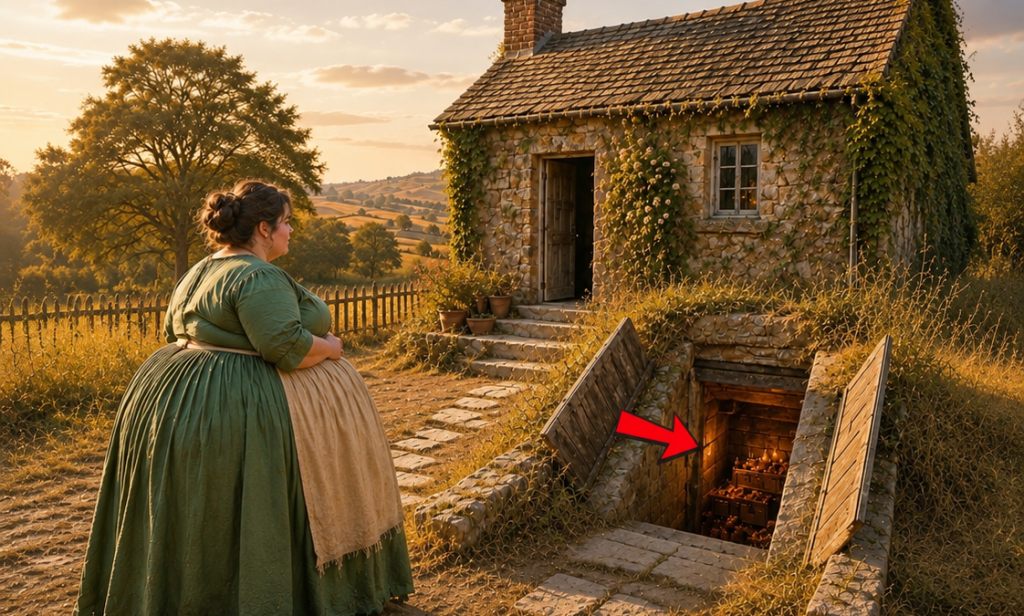
Her fingers closed around the tarnished iron ring, and she pulled. A section of stone floor lifted like a trapdoor, groaning on hinges that hadn’t moved in decades. Below was not a crawlspace — it was a room. Small, six feet by six, smooth stone walls, a low ceiling that forced her to crouch.
By candlelight she saw a wooden chest bound in iron, and beside it, sitting upright as if placed there with deliberate care, a leather journal.
Inside the cover, in careful faded ink: Samuel Carter, his record, begun the year of our Lord 1841.
Clara read late into the night. Samuel had been the Whitmore groundskeeper for over two decades, trusted by the family’s founder, Elias Whitmore — a man who’d watched his own sons grow careless with money and concluded that if the fortune passed to them directly, it would vanish within a generation. So Elias hid a portion of it. Gold. Land deeds. Mineral rights never registered with the county. He gave it all to Samuel with one instruction:
“Hide it where proud men will never look. The man who deserves what is here will be the one who stays when everyone else has gone.”
Clara sat back against the stone wall, the candle flickering, and understood with total clarity: Elias had built this trap for exactly the kind of sons who would one day hand this “worthless” cabin to a widow as a cruel joke.
She opened the chest. Gold coins. Old bills. Land surveys. Mineral rights registered in Elias Whitmore’s name — including 412 acres never legally transferred to his sons at all.
She needed help she could trust, and there was only one man who came to mind — Caleb Walker, a quiet rancher who’d stopped his horse weeks earlier just to help her carry lumber, never once asking why. When she finally showed him the chamber, he read every document in silence, then looked up at her, stunned.
“Clara,” he said slowly, holding up a survey map. “This mineral claim — it covers the eastern ridge.” His jaw tightened. “Nathan’s been running a silver mine there for eight months.”
Clara went very still. “On my land.”
“On your land,” Caleb confirmed.
They rode two days to Billings to find an independent lawyer, Edmund Cross, who spent nearly an hour reading the documents in total silence before finally looking up.
“Mrs. Whitmore,” he said, “what you have here is extraordinary — and it’s going to start a war.”
He filed a petition in the territorial court in Helena, far from Whitmore influence, and warned Clara she’d need three weeks of complete silence while it processed. Three weeks of walking past the Whitmore brothers, saying nothing, giving away nothing — while sitting on a secret that would strip them of nearly half their land and eight months of stolen silver.
Nine days in, Nathan showed up at her repaired cabin, eyes scanning her mended walls with open suspicion.
“I heard you rode to Billings,” he said. “What kind of business?”
“Estate matters,” Clara answered evenly. “Nothing that concerns you.”
He left unsatisfied. She exhaled only once he was out of sight.
Then, on the fourteenth day, a letter arrived from Cross: The court has registered the petition. Official documentation within five to seven days. Prepare yourself, Mrs. Whitmore.
Five days later, Cross rode in himself — which he had never done before — carrying the authenticated court papers. Clara’s claim was real. Legal. Unshakable.
“The county land office gets notified by Monday,” Cross warned her. “I’d suggest you not be alone when it happens.”
She wasn’t. She rode straight to Caleb’s ranch to tell him it was done — that every acre, every ounce of silver Nathan had pulled from that ridge, now legally belonged to her.
But she never made it to Monday quietly.
That Sunday evening, just as the light was dying, she heard horses. More than one. Coming fast from the direction of the main house.
Nathan swung down before his horse even stopped, his face a color she had never seen on him before — and this time, he wasn’t laughing.
“Clara,” he snarled, “what in God’s name did you do?”
Part 3
“I don’t know what you’re referring to,” Clara said, and her voice came out steadier than she felt.
“Don’t.” Nathan’s word cracked like a whip. “I got a message today. A filing in Helena. Mineral rights. The eastern ridge. The north corridor.” His jaw was so tight it looked painful. “Where did you find it?”
“Find what?” she asked.
“Whatever Carter left.” His voice dropped, and for the first time she heard something underneath the fury — fear. “Grandfather’s papers mentioned a provision. Randall always called it an old man’s fantasy.” He stepped closer. “You need to withdraw that filing, Clara.”
That was when Caleb stepped out from the side of the cabin, arms loose at his sides, face utterly still. He hadn’t announced himself. He simply was there, the way he always seemed to be exactly when she needed him most.
“Evening, Nathan,” Caleb said quietly.
Gerald, still mounted, sneered down at him. “This ain’t your business, Walker.”
“I reckon it is.” Caleb didn’t even glance at him. His eyes stayed locked on Nathan. “Mrs. Whitmore asked me to be here. So here I am.”
Nathan’s breathing changed — the recalibration of a man who’d ridden over to intimidate a frightened widow and instead found something he hadn’t accounted for. He got back on his horse without another word. Before they rode off, he looked at Clara one last time — searching for the woman he thought he understood, and finding someone else entirely standing in her place.
Monday arrived exactly as important days sometimes do — quietly, with no fanfare. Clara had gathered witnesses: Mabel Greer, sharp-tongued and unshockable, who’d run the dry goods store for thirty years; Pastor Holt, whose voice carried; Amos Reed and Martin Coyle, old friends of Thomas’s who’d never forgiven the brothers for the way they’d treated his widow.
The county deputy arrived first with the formal notification. Fourteen minutes later, hooves thundered up the trail — all three brothers this time.
Randall came up the porch steps first, his fury nothing like Nathan’s heat. His was cold. Still. Calculating.
“Mrs. Whitmore,” he said. “I’d like to speak with you privately.”
“That won’t be possible,” Clara answered. “Anything you say to me today, you say in front of everyone in this room.”
“This filing,” Randall said, voice tight with control. “You understand what you’re claiming? A producing silver operation. Acreage under active ranch management my entire adult life—”
“I’m claiming what the territorial court has already authenticated as mine,” Clara cut in. “This isn’t a claim, Randall. It’s a finding. There’s a difference.”
His eyes narrowed. “Where did you find the Carter documents?”
The room went utterly silent.
“Right here,” Clara said, “in this cabin your family gave me as a joke.”
The words landed exactly as she intended — heavy, precise, impossible to take back.
“The man who built this ranch,” she continued, “knew his sons. He hid what he hid because he knew you’d never think to look somewhere you’d already decided was worthless.” She held Randall’s gaze. “He was right.”
Randall stared at her for a long, unreadable moment. Then, quietly: “Name your price.”
“I’m not selling,” Clara said.
What followed was not the quick surrender she might have imagined, but a brutal, months-long legal war. The Whitmores hired Fletcher Cain, the most feared property attorney in the territory — a man who had never lost. When that failed to shake her, Nathan grew desperate enough to secretly bribe county officials to stall the transfer. When Cross uncovered it, Cain withdrew from the case entirely rather than have his name attached to a bribery scandal.
Then the retaliation turned personal. Randall — cold, methodical Randall — began quietly crushing everyone who’d stood beside her. Mabel’s store debt was suddenly called in by a mystery buyer. Martin Coyle was hit with a fabricated property dispute. Amos Reed’s son was fired from the Whitmore ranch out of pure spite.
Clara didn’t flinch. She paid off Mabel’s note through Cross’s office — creating a paper trail that tied Randall’s retaliation directly to the lawsuit. Caleb hired Amos’s son on the spot. Together, they dismantled every fabricated attack Randall threw at them, one by one.
And then, the week before the final hearing, Randall came to her cabin alone. No brothers. No lawyers. Just his hat in his hands.
“What we did at that meeting,” he said quietly, “was not right. I knew it even then.”
Clara said nothing, letting him continue.
“I want to settle. Properly. Not a lowball number — a real settlement.” He met her eyes. “Our grandfather would have liked you.”
She agreed — but only with one condition: a full, honest accounting of every ounce of silver Nathan had pulled from her land, calculated at real market value, not a convenient number his lawyers invented.
Randall delivered it unedited. The number was staggering — and completely fair.
The papers were signed on a cold Thursday morning above the hardware store. Four hundred and twelve acres. The mineral rights. Eight months of stolen silver, fully repaid. And in Helena, the court record stood forever — sealed, authenticated, unshakable.
Clara walked out into the December air and found Caleb waiting at the bottom of the steps, along with Mabel, Francis Chen, and half the town who’d quietly chosen her side.
That winter, she began something she’d been dreaming of since three women first knocked on her door seeking help — a resource fund for widowed and dispossessed women just like her, funded by Elias Whitmore’s forgotten fortune. Women came the way water finds low ground — Francis Chen kept her land. Sarah cleared her debts and opened a dressmaking shop. A woman named Margaret finally won a six-year mining dispute on appeal.
In May, Clara married Caleb in the garden behind the very cabin that had once been a family’s cruel joke — surrounded by everyone who had stood beside her when it mattered.
Nathan moved away to Billings, humbled. Randall stayed, quieter and wiser. And one day, even Gerald showed up at her door, hat in his hands, needing help with a dispute of his own.
Clara opened the door without hesitation.
“Come in,” she said. “Tell me what you have.”
Because she had learned something in that broken-down cabin nobody wanted: the measure of what you’re given isn’t what others decide it’s worth.
It’s what you choose to build from it. 🕯️