I paused in the hallway, my shoulder bag heavy and my nerves already humming with preemptive static. My husband, Brian, had texted me at two o’clock with a classic harbinger of dread: Small thing happened. Nothing serious. We’ll talk when you get home.
After sixteen years of marriage, I knew that specific code phrase inside and out. It meant something was aggressively serious, and Brian was desperately trying to buy time to construct a narrative.
My name is Ellen Marsh. At forty-one, I’ve spent fourteen years as a purchasing manager for a rigorous manufacturing firm. My entire professional life is built on anticipating disasters before they hit the assembly line, separating actual structural failures from smoke and mirrors.
So when I stepped into our living room that evening, I took one look around and instantly identified the category we were dealing with.
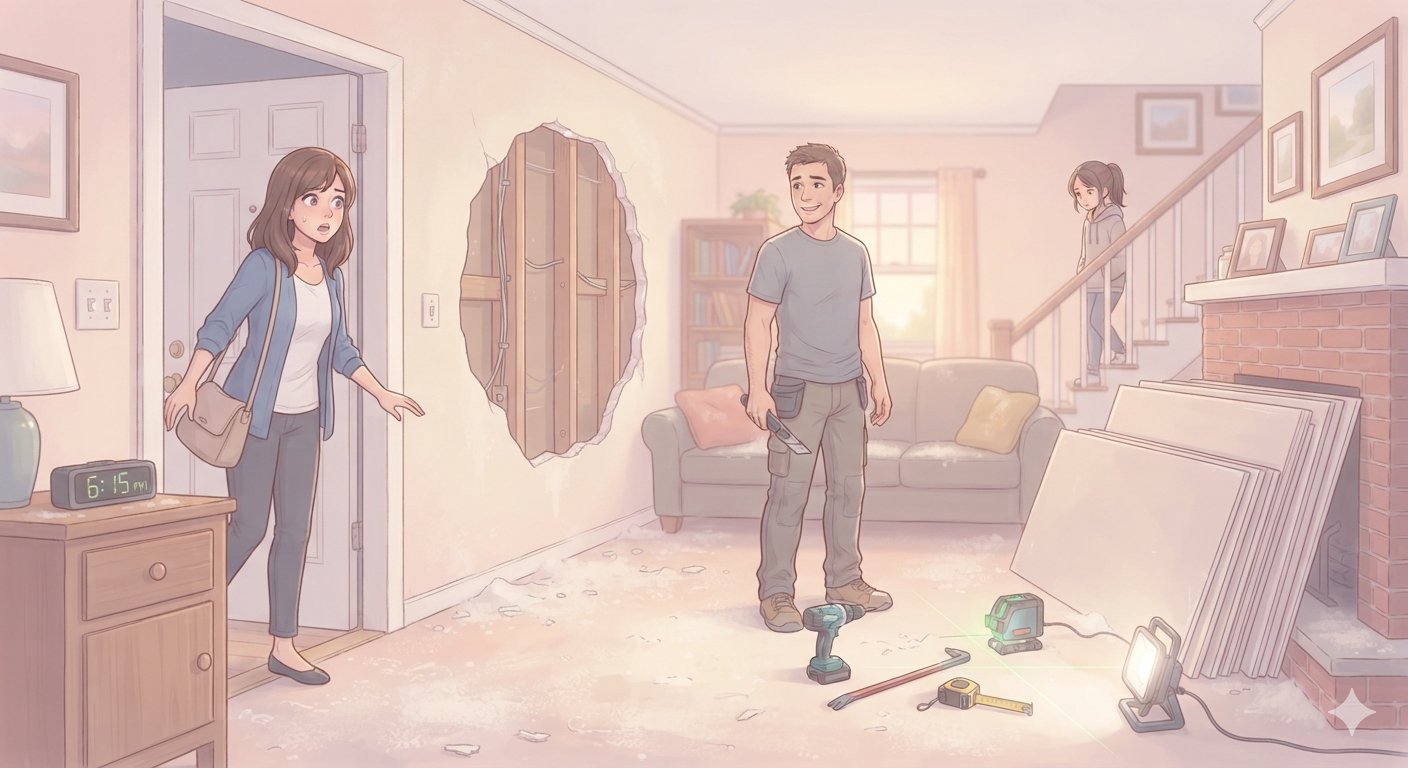
A four-foot vertical expanse of our drywall had been brutally ripped away, exposing gray studs and tangled insulation. Our sofa had been shoved clear across the hardwood. Neat, square blocks of plaster were stacked like bricks by the hearth. And right in the center of the debris stood Brian, holding a heavy utility knife.
I stared at him. Then at the cavernous void in the wall. Then back to him.
“What happened here?”
Brian gave me that particular, forced look of casual innocence people wear when they are praying you won’t look too closely.
“It looks a lot worse than it actually is.”
That sentence has never once preceded good news. “What happened to the wall?”
He launched into an explanation. A loose electrical outlet. He popped the plastic cover off. The old drywall mysteriously crumbled around the box. Figuring he needed to see what was going on, he just… opened it up a bit.
I stared at the gaping hole. “You demolished half our living room because of a loose outlet?”
“I got a little carried away,” he shrugged, offering a weak smile. “I’ll fix it.”
Then my eyes dropped to the floorboards.
A cordless drill. A professional torpedo level. A steel pry bar. A tape measure.
Everything was arranged with clinical precision, within arm’s reach. These weren’t tools dropped in a panic during an unexpected accident. They had been laid out with absolute intent. And the drywall panels weren’t haphazardly smashed—they had been scored and cut with surgical, deliberate care.
“You planned this,” I said flatly.
Brian’s breezy expression faltered. “What?”
“This didn’t happen because drywall cracked. You planned to open this wall.”
He rubbed a tired hand across his forehead. “I knew you were going to make a whole production out of this.”
“I went to work this morning with a fully intact house,” I countered, gesturing wildly toward the crater. “I came home missing four feet of it.”
He sighed, dropping his shoulders. “I’m tired. Let’s eat dinner. I’ll explain everything later.”
Before I could fire back, the familiar, light tread of footsteps echoed down the stairs.
Our twelve-year-old daughter, Maddie, is an anomaly of observation. Always has been. When she was six and we casually mentioned getting a dog, her very first question wasn’t excitement—it was an interrogation about breeds, expected adult size, dietary needs, who would walk it, and family allergy histories.
So when Maddie walked into the living room, took in the massive, terrifying hole in our wall, and said zero words, my parental instincts flared. She had already seen it. And worse, she didn’t want to talk about it in front of Brian.
“Were you home when Dad did this?” I asked, keeping my eyes fixed on her.
Before Maddie could form a syllable, Brian jumped in. “She was upstairs doing homework most of the afternoon.”
Maddie glanced swiftly at him, then back to me. “Yeah.”
Without missing a beat, she grabbed a yogurt from the fridge and retreated back upstairs. That split-second glance spoke volumes.
Dinner was agonizing. Maddie picked at her food in near-total silence, and every time I tried to steer the conversation toward the living room, her eyes darted nervously to Brian. Brian, meanwhile, engaged in Olympic-level conversational evasion—ranting about office politics, lawn care, and local traffic patterns. Anything to avoid the gaping wound in our home.
As soon as we cleared the table, Brian excused himself to put his tools away in the basement.
I walked into our bedroom and closed the door. Five minutes later, a soft, tentative knock tapped against the wood.
“Come in.”
Maddie slipped inside, clicking the door shut behind her.
“Is Dad still downstairs?” she whispered.
“Yes.”
She sat on the edge of the mattress, her small shoulders tense. “Mom… Dad wasn’t fixing an outlet.”
My stomach plummeted. “What was he doing?”
“He was searching for something.”
I stared at her. “In the wall?”
She nodded solemnly. “I came downstairs around eleven today for a snack. He already had the drywall cut wide open.”
“Did you see what he was doing?”
“He had a flashlight. He kept pushing the fiberglass insulation aside, running his hands along the wooden studs.”
“Did you ask him about it?”
“He claimed it was electrical work.” Maddie shook her head. “But it didn’t look like he was checking wires. It looked like he knew something was supposed to be hidden in there.”
She hesitated, her fingers twisting the hem of her shirt. “And Mom? He found something.”
My heart thrummed against my ribs. “What?”
“I couldn’t see it clearly—it was small. He shoved it straight into his coat pocket the second he noticed me watching.” She looked down, guilt washing over her face. “He told me not to tell you. He said it would upset you.”
I reached out, lifting her chin so she met my eyes. “Maddie. Look at me. You told me now.”
“Yes.”
“That matters. You always tell me doing the right thing can be hard.”
She swallowed hard, a flicker of relief crossing her features. “Not telling you felt wrong.”
“You made the right choice.”
Ten minutes later, I walked downstairs. Brian was packing his drill into its plastic case when he heard my footsteps.
“Hey,” he started, straightening up. “I was just coming up to—”
“Brian,” I interrupted, my voice dangerously calm. “Maddie told me.”
His body went entirely rigid.
“She told me about the flashlight. She told me you were searching inside the wall. And she saw you pocket whatever you found.”
Silence stretched heavily between us.
“Whatever this is,” I said, stepping closer, “tell me the truth right now.”
Brian let out a long, ragged breath, walked over to the workbench, and sat down heavily on the edge.
“I should’ve told you six months ago,” he murmured.
I stared at him, bewildered. “Six months?”
“I found something in the attic.”
“What?”
“An envelope.” He hesitated, his eyes dropping to the concrete floor. “It had your father’s handwriting on it.”
The breath caught entirely in my throat. “My father?”
Brian nodded. My dad had been gone for twelve years, passing away suddenly from a heart attack at sixty-seven. He was an accountant by trade—quiet, utterly dependable, emotionally restrained, and rarely prone to grand gestures. He had always shown up, but he never knew how to express what he felt. Maddie had been an infant when he died, never knowing him at all.
“What was something written by Dad doing hidden in our attic?” I whispered.
“This used to be your grandmother’s house,” Brian reminded me gently.
It was true. My grandparents built the place in 1952. My mother grew up within these walls, and I spent my childhood here. After Mom passed away, the house eventually transferred to my name.
Brian explained that he had stumbled upon the envelope months ago while repairing a stuck attic vent.
“Was it addressed to me?”
“Yes.”
“Then why in God’s name didn’t you give it to me?”
His expression tightened with regret. “I thought it might contain something heavy. Something painful.”
“So you appointed yourself the gatekeeper of my own family’s history?”
“I didn’t open it,” he defended weakly.
“That isn’t the point, Brian!”
“I know.” He dragged a hand down his face. “I tucked it back where I found it. But I kept obsessing over it.”
“For half a year?”
“Yes.” He admitted he had snuck back up to the attic multiple times. Sometimes he resolved to hand it over; other times he debated tearing it open himself, terrified the contents would shatter me. Then, one day, he went up to retrieve it—and the envelope was gone.
“You lost it?”
“No. I always hid it in the exact same spot. But someone—or something—had moved it.”
Desperate to find it, Brian’s mind latched onto an old family legend. My grandmother had survived the Great Depression and harbored a lifelong, stubborn distrust of banks. Years prior, my mother had once stumbled upon four hundred dollars tucked behind a baseboard during plumbing repairs. Grandma had literally used the house framing as her personal savings account.
Convinced there might be more stashed within the architecture, Brian’s imagination spiraled. And that led him straight to tearing apart our living room wall.
“So you started butchering the house?” I demanded.
“Yes.”
“Without saying a word to me.”
“Yes.”
I stared at my husband, anger and disbelief warring in my chest. “And did you actually find anything?”
Slowly, reluctantly, Brian reached into his jacket pocket. He pulled out two weathered, yellowed envelopes bound together by a dry, brittle rubber band.
My hands went ice cold.
“I haven’t opened them,” he whispered, sliding them across the workbench toward me.
The moment my trembling fingers brushed the paper, the ancient rubber band snapped.
The top envelope bore a single, elegant word scrawled in black ink: Ellen. My name. In my father’s precise, accountant’s handwriting.
The second envelope read: Margaret. My mother’s name. Also in Dad’s hand.
Brian watched me anxiously. “I should have given you that first one six months ago. I am so sorry.”
With trembling fingers, I slid the first letter out. It unfolded into two pages of my father’s handwriting.
While some personal reflections remained strictly between him and me, the core of the letter changed everything. Eight months before he suffered the fatal heart attack, Dad had been diagnosed with a severe, degenerative heart condition—one his doctors warned would drastically shorten his life. He never told my mother. He never told me.
Instead, he spent his final months writing. He confessed in ink that he had always been profoundly incapable of voicing his emotions aloud. He addressed my career choices—decisions he had once criticized out of fear, but now realized I had been entirely right about. He wrote about Brian, admitting he had judged him too harshly in our dating days.
Then, he wrote about Maddie. I had been pregnant when he died, and he carried a quiet intuition that she would be born with my exact spirit: observant, careful, hyper-aware of the world. He explicitly urged me never to dull that curiosity in her.
And then came the lines that completely undid me.
He wrote that he had never mastered the art of saying I love you in a way people could easily hear, and he desperately hoped reading his words now would bridge that gap. He mentioned the house, noting that the old place would take care of us if we took care of it, because Grandma and Grandpa had built it to last. He noted that there were still hidden pieces of our family tucked away in its bones—not monetary wealth, but remnants of where we came from.
At the very bottom, signed in stark, formal lines: William Edward Marsh.
Not “Dad.” His full legal name. The signature he reserved for moments of absolute, binding truth.
I sat frozen on the workbench, the pages clutched tightly to my chest. Brian sat beside me in heavy silence, offering no excuses, just a steady, grounding presence.
“He knew he was sick,” I choked out.
“What?” Brian asked softly.
“He knew he was dying, and he wrote down everything he couldn’t bring himself to say out loud.”
Slowly, I picked up the second envelope. Margaret.
Mom had passed away three years after Dad. She had lived and died never knowing this letter existed.
“This was for her,” I whispered.
“Yes.”
“She’s gone, Brian.”
“I know.”
After a long, agonizing pause, I carefully opened my mother’s letter.
It was briefer. Dad explained his hidden diagnosis, confessing that he had kept it a secret because he knew Mom would have sacrificed her entire existence to nurse him, and he couldn’t bear to watch her do that. He admitted it was a deeply flawed decision, refusing to ask for forgiveness for a mistake born of stubborn protection.
He wrote that he had loved her completely—even when he loved her clumsily—and that those clumsy mistakes never invalidated the truth of his devotion. Then came a sentence I knew would stay etched in my soul forever: The house is the best thing I ever gave her, next to you. Whenever I built something, I built it for the people I loved, even when I didn’t know how to speak the words.
I folded the papers slowly, resting my hands on the cold wood of the table. I turned my gaze to my husband.
“You sat on my father’s final words to me for half a year.”
“I know.”
“You convinced yourself you were protecting me.”
“Yes.”
“From a letter you hadn’t even read.”
“Yes,” he said, his voice thick with shame. “It was the wrong call. Every single part of it.”
“You’re damn right it was.” I looked him square in the eye. “You do not get to unilaterally decide what emotional information I am allowed to process, Brian.”
“I understand. I completely understand.”
“So what happens next time?”
“I tell you immediately.”
“Even if you’re terrified it will upset me?”
“Especially then.”
I nodded, letting the tension slowly bleed out of my shoulders. “And you are fixing that wall.”
A microscopic ghost of a smile touched the corner of his mouth. “Tomorrow morning. First thing.”
Later that evening, I climbed the stairs and pushed open Maddie’s bedroom door. She was sitting at her desk with an open textbook, though it was blatantly obvious she hadn’t absorbed a single word of it.
“Mom?” she asked, looking up.
“Hey.”
“Did you find out what Dad was digging for?”
“I did.”
“What was it?”
“Letters.”
“From who?”
“Your grandfather.”
She went very still. “The grandfather I never met?”
“Yes.”
“What did he say?”
“Things he couldn’t figure out how to say while he was alive.”
Maddie digested that for a long moment, tilting her head. “That’s kind of sad.”
“It is.”
“But also… kind of good?”
I smiled, stepping further into the room and sitting on the edge of her bed. “Both. Definitely both.”
She considered this, picking at the corner of her notebook. “Was Dad wrong not to tell you right away?”
“He was.”
“But he thought he was helping.”
“He did.”
“What should he have done instead?”
“Told me the truth,” I answered firmly. “Even if he was worried it might make me upset.”
Maddie’s eyes lit up with sudden realization. “That’s what I did today.”
“Yes, it is.”
“I told you about the flashlight, even though Dad asked me to keep it a secret. Because keeping a secret from you felt worse.”
“You made the exact right choice,” I told her softly.
She offered a proud, tight-lipped smile. “Even though it was hard.”
“Especially because it was hard.”
She paused, her brow furrowing slightly. “Mom… did Grandpa write anything about me?”
“He did.”
Her eyes widened in wonder. “What did he say?”
“He wrote that you would grow up paying close attention to everything around you.”
A massive grin broke across her face. “He knew that before I was even born?”
“Yes.”
“Was he right?”
“Incredibly right.”
She glanced around her bedroom walls, her gaze thoughtful. “So… he’s kind of still here, isn’t he?”
“In a way.”
“In the house?”
“Yes.”
I laughed softly. “In the walls.”
She let that sink in. “People leave pieces of themselves behind, even after they’re gone.”
“They do.”
“And if you pay close attention, sometimes you find them.”
“Exactly.”
An hour later, Brian and I sat quietly at the kitchen table, nursing mugs of tea. Through the open doorway, the jagged four-foot hole in our living room wall stared back at us. The displaced couch, the drywall stacks, the letters resting neatly on the kitchen counter—it all formed a bizarre mosaic of our life.
“My grandmother hid cash in these walls,” I murmured, wrapping my hands around my mug.
Brian nodded. “And your father hid his heart.”
“I wonder what else is buried in this old place.”
He glanced toward the living room framing. “Do you want to keep looking?”
“Not tonight.” I shook my head. “Whenever we’re ready.”
I reached across the table, sliding my hand over his. “But next time we look, we do it together.”
“Together,” he agreed instantly.
“And if you find anything unexpected first?”
“I tell you.”
“Immediately.”
“Yes. Immediately.”
We sat in comfortable silence for a long stretch, listening to the old house settle around us. Then, a line from Dad’s letter flickered back into my mind.
“He was right about you, you know.”
Brian frowned, tilting his head. “Your father?”
“He never told you he liked you to your face.”
“No, he definitely didn’t.”
“But he wrote it down. He said some men build things for the people they love because they simply aren’t equipped to say the words out loud.”
Brian looked away toward the mutilated drywall, then back to me, the subtext heavy in his eyes.
“That sounds pretty familiar,” he said softly.
“It does.” I squeezed his fingers. “But you still have to say the words, Brian.”
He held my gaze, dropping the defensive armor entirely. “I love you.”
No grand speeches. No theatrical performances. Just my husband.
“I love you too,” I replied. Then, nodding toward the living room disaster, I added, “And next time, you give me a full briefing before you rip four feet of our house down.”
He threw his head back and laughed—a genuine, unburdened sound. “I promise.”
Our house had been standing since 1952. More than seven decades of birthdays, holidays, blazing arguments, desperate repairs, hidden money, tucked-away letters, and buried secrets. It was a monument to flawed people trying their absolute best to love each other well, even when they botched the execution.
The house was still standing. Still holding all of it.
And when we were finally ready to uncover whatever else remained hidden inside those walls, we would do it side by side. That, I finally understood, was the entire point. Not simply that the structure had endured the test of time, but that our family could, too.