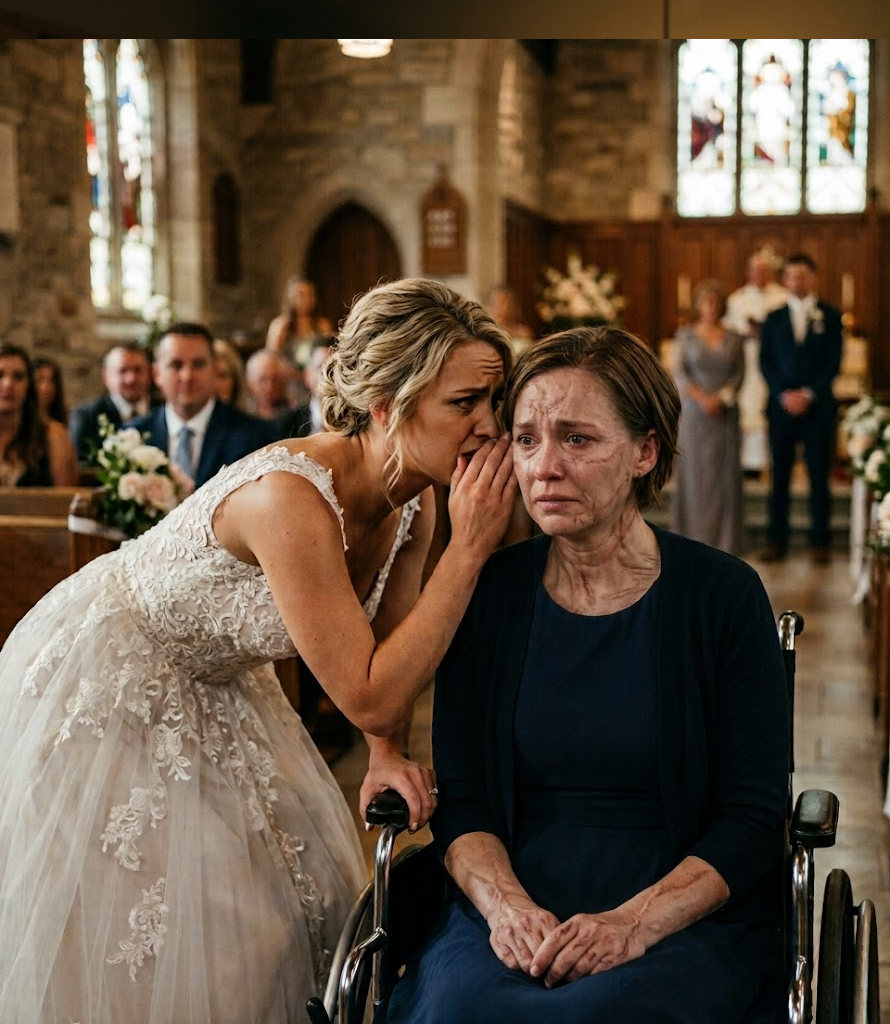
Twelve years after a house fire left me scarred and in a wheelchair, I went to my younger sister’s wedding. The moment she saw me, she leaned down and whispered, “Please sit in the back. I don’t want you in the photos.” I didn’t argue. I was about to move when the groom’s mother suddenly asked my father, “Does she still not know what happened that night?” The look on my family’s faces told me this was no longer about wedding pictures.
My sister’s name was Brooke, and until that morning, I would have said we were close.
Not perfect, but close.
There were seven years between us. By the time Brooke was old enough to remember much about childhood, I had already become the sister in the wheelchair.
The fire happened when I was seventeen and Brooke was ten. I remembered almost nothing from the worst part of it. There were flashes sometimes — smoke against a ceiling, heat on one side of my face, somebody yelling my name — but doctors told my parents that memory loss after severe smoke inhalation and trauma was not unusual.
What I knew came mostly from what my parents had told me.
A fire had broken out downstairs during the night.
Smoke spread quickly.
Brooke and I were both trapped upstairs.
Firefighters got us out.
She suffered smoke inhalation and a few minor burns.
I suffered far worse.
That was the story.
For twelve years, I had never seriously questioned it.
Our parents, Neil and Cynthia, rarely discussed that night. Whenever I asked what exactly had happened, Dad would say there was no point dragging me back through something my mind had obviously chosen to forget.
Mom was softer about it.
“You survived, Avery. Brooke survived. Sometimes that has to be enough.”
Eventually, I accepted that answer.
Brooke did too.
If anything, she seemed even less interested in talking about the fire than I was.
We built our relationship around everything else.
She called me when she got her first serious boyfriend, when she failed a college class, when she thought she might quit her first job, and once at two in the morning because she had cut her own bangs and immediately regretted it.
When she met Caleb, I knew about him before our parents did.
“He’s boring,” she told me after their third date.
“Then why did you go out with him three times?”
“Because boring is peaceful.”
Six months later, she was in love with him.
Caleb was easy to like. He was patient without making a show of it, funny without needing everyone to laugh, and he never treated my wheelchair like the most interesting thing about me.
His mother, Judith, was much the same.
She had spent most of her career working for an insurance company before retiring, although I never knew exactly what her job had been. She was the type who remembered dates, faces, and oddly specific details people mentioned once in passing.
Brooke and Caleb dated for three years before he proposed.
For almost a year, Brooke talked about little else besides the wedding.
She wanted white roses, long tables, old family photographs near the guest book, and a ceremony in a renovated church outside town.
She asked my opinion on everything.
Which invitation looked less formal?
Should she wear her hair up?
Was a five-tier cake ridiculous?
Did I think Caleb would hate the first-dance song she picked?
I designed the seating cards for her.
I helped choose the bridesmaids’ dresses.
I sat through two cake tastings and one disastrous appointment where Brooke cried because the florist had misunderstood what she meant by “soft green.”
There was never any suggestion that she was embarrassed by me.
That was why the wedding morning made so little sense.
Looking back, though, things had started changing about three months earlier.
It began at a family dinner.
Judith had come over with Caleb to discuss arrangements for the rehearsal dinner. Dad mentioned that our old house had once stood on Burnet Street, and Judith stopped with her glass halfway to her mouth.
“Burnet Street?”
Dad looked at her.
“Yes.”
“What number?”
Mom answered before he could.
“Forty-eight.”
Judith became very still.
Then she said, “Was that the house that burned?”
The question seemed harmless.
Dad didn’t treat it that way.
His shoulders tightened.
“Yes. Years ago.”
Judith looked at me.
I smiled awkwardly.
“That’s how I got all this.”
I gestured toward the scars along my neck and left arm.
Judith did not smile back.
Instead, she asked, “What year was that?”
“Twelve years ago,” Mom said quickly. “A terrible accident.”
Judith looked at Dad again.
Then she changed the subject.
At the time, I forgot about it.
Dad did not.
After Judith left, he complained that Caleb’s family asked too many personal questions.
Brooke laughed.
“She asked about an address, Dad.”
“She’s nosy.”
“She worked in insurance. Maybe she remembered the claim.”
Dad’s face changed for less than a second.
I noticed it.
I just didn’t understand it.
A few weeks later, Brooke called me.
“Do you remember much from the fire?”
The question surprised me because Brooke almost never mentioned it.
“No. Why?”
“Nothing. I was just thinking about it.”
“What do you remember?”
There was a pause.
“Not much either.”
That was true, as far as I knew.
She had always said she remembered waking in the hospital and seeing Mom beside her. She remembered firefighters. She remembered smoke.
Nothing else.
“Maybe that’s a good thing,” I told her.
“Maybe.”
After that, she grew strangely anxious.
She called less often.
When we were together, she sometimes looked as though she wanted to say something and then changed her mind.
Mom became tense too.
Dad was worse.
Once, while I was at their house, I heard him and Mom arguing in the kitchen.
“We agreed,” Dad said.
Mom answered too quietly for me to hear.
Then Dad said, “Nothing good comes from opening this again.”
When I walked in, they stopped.
“What are you talking about?”
“Wedding stress,” Mom said immediately.
It was such a bad lie that I almost laughed.
Still, I let it go.
The week before the wedding, Brooke asked if I had finalized my dress.
I told her I had.
It was navy blue, simple, with a neckline that left part of the scarring along my shoulder visible.
Brooke hesitated.
“Do you have anything with sleeves?”
I stared at her through the phone.
“Why?”
“No reason.”
“You’ve never cared about my scars before.”
“I don’t.”
“Then why ask?”
She let out a frustrated breath.
“Avery, forget I said anything.”
That was our last conversation before the rehearsal.
At the rehearsal dinner, Judith barely spoke to Dad.
More than once, I caught her watching him.
Caleb noticed too.
“Mom’s being weird,” he whispered to me.
“So is my whole family.”
We both laughed.
Neither of us knew how accurate that was.
The next morning, I arrived at the church early.
Mom was helping Brooke in a side room. Dad stood near the front talking to the photographer.
Judith came over first and hugged me.
“You look lovely.”
“Thank you.”
Her expression changed when she looked toward Dad.
“You okay?” I asked.
“Yes.”
She clearly wasn’t.
Before I could ask more, Brooke appeared.
She looked beautiful.
For a few seconds, I forgot every strange conversation from the past three months.
Then she saw me.
The smile disappeared from her face.
Her eyes moved to my shoulder.
Then to the photographer.
Then to Dad.
She walked over quickly.
“Avery, can I talk to you?”
“Of course.”
She bent toward me.
“Please sit in the back. I don’t want you in the photos.”
The words were quiet enough that most guests could not hear them.
Mom could.
Dad could.
Neither of them looked surprised.
I stared at Brooke.
“You don’t want me in the photos?”
She swallowed.
“I just want today to look… right.”
I felt heat rush to my face.
For years, Brooke had defended me whenever anyone stared.
Now she couldn’t even look at me.
I glanced at Mom.
She lowered her eyes.
Dad stepped closer.
“Don’t turn this into a scene, Avery.”
That sentence decided it for me.
I wasn’t going to argue for a place in my own sister’s wedding.
“Fine.”
I reached for my wheels.
That was when Judith spoke.
“Neil.”
Dad froze.
Judith stood beside the first row.
She looked at him for several seconds before asking:
“Does she still not know what happened that night?”
Brooke straightened.
“What does that mean?”
The confusion on her face was immediate.
Real.
That was the first moment I understood that whatever Judith was talking about, Brooke did not know either.
Dad’s face hardened.
“Judith, stop.”
Caleb came out from the side room.
“Mom?”
Judith looked at him, then at Brooke and me.
“I thought they knew.”
“Knew what?” I asked.
Dad stepped forward.
“This is not the place.”
Brooke turned toward him.
“Dad, what is she talking about?”
“Nothing you need to deal with today.”
Judith gave him a look I had never seen from her before.
“They’re both adults.”
Mom whispered, “Please.”
I looked at her.
“What happened that night?”
She began crying.
My stomach dropped.
Dad said, “Avery, there are parts of that night you don’t remember. Your doctors told us not to push you.”
“That was twelve years ago.”
“You were traumatized.”
“So tell me now.”
He said nothing.
Brooke reached for my hand.
She was shaking.
“Dad, tell us.”
Judith opened her handbag and removed a thin folder.
Dad immediately said, “Where did you get that?”
That was the wrong thing to ask.
Because suddenly none of us cared about the wedding anymore.
Judith told us that when Dad mentioned Burnet Street months earlier, she remembered the fire.
At the time, she had worked in the claims department for the company that insured our house.
She had not handled the case herself, but she remembered it because one detail had caused repeated questions internally.
“What detail?” Brooke asked.
Judith opened the folder.
“A witness statement.”
Dad closed his eyes.
Mom sat down.
Judith handed me a photocopy.
The statement belonged to a woman named Mrs. Alvarez, who had lived across the street from us.
I remembered her vaguely.
She had brought food to the hospital after the fire.
My eyes moved through the document until one sentence stopped me.
At approximately 2:11 a.m., I observed the older Nolan daughter outside the residence near the driveway.
I read it twice.
Then again.
“What does this mean?”
No one answered.
I looked at Judith.
“She says I was outside.”
“Yes.”
“But I was found upstairs.”
“Yes.”
Brooke took the paper from me.
Her face went pale.
“That’s impossible.”
Judith pulled out another page.
It was part of the firefighters’ report.
Two female minors had been recovered from the upper level.
One near the rear bedroom.
One in the hallway outside that room.
I looked at Dad.
“If I was outside before the firefighters found me upstairs, how did I get back inside?”
He rubbed both hands over his face.
“Your memory was badly affected. We made a decision not to force you to relive it.”
“That isn’t an answer.”
Mom suddenly said, “We thought it was better.”
Brooke stared at her.
“For who?”
Mom began crying harder.
Brooke turned toward Judith.
“Do you know?”
Judith hesitated.